
Survival Of The Fittest
Author - Ovais Ali Khokhar
Survival of the Fittest, The Biological Imperative
The idea of Survival of the Fittest is very powerful and often talked about in the Science world but people often do not understand where it came from. This idea serves as the foundation of biology. This idea basically was thought and presented by a man named Herbert Spencer in 1864 after he read a book called “On the Origin of Species” written by Charles Darwin. Later on, Darwin used this term to explain Natural Selection. This theory explains an idea that all living things have different traits, they survive differently and are spread over different places on earth, and because there is not enough food, water or space, they have to struggle hard and fight to survive. The ones that are best suited to their environment are the ones that will survive and have offspring. It is very important to understand that being the fittest does not always mean being the strongest or the fastest, it means being the right fit for the atmosphere, or adopting the survival instincts according to their environment and do as the requirement of the time demands. For example during the ice age, the woolly mammoth was considered the strongest creature on earth, but when the glaciers started melting, and the temperature started rising eventually, their thick fur and big bodies became deadly disadvantages for them, in contrary to that, small rodents and versatile mammals, which apparently were the weak creatures, their small bodies could survive on less food and they could also burrow themselves to avoid heat, this is how the phenomenon of survival of the fittest works.
Digital Darwinism,Connecting Biology to Modern Economy
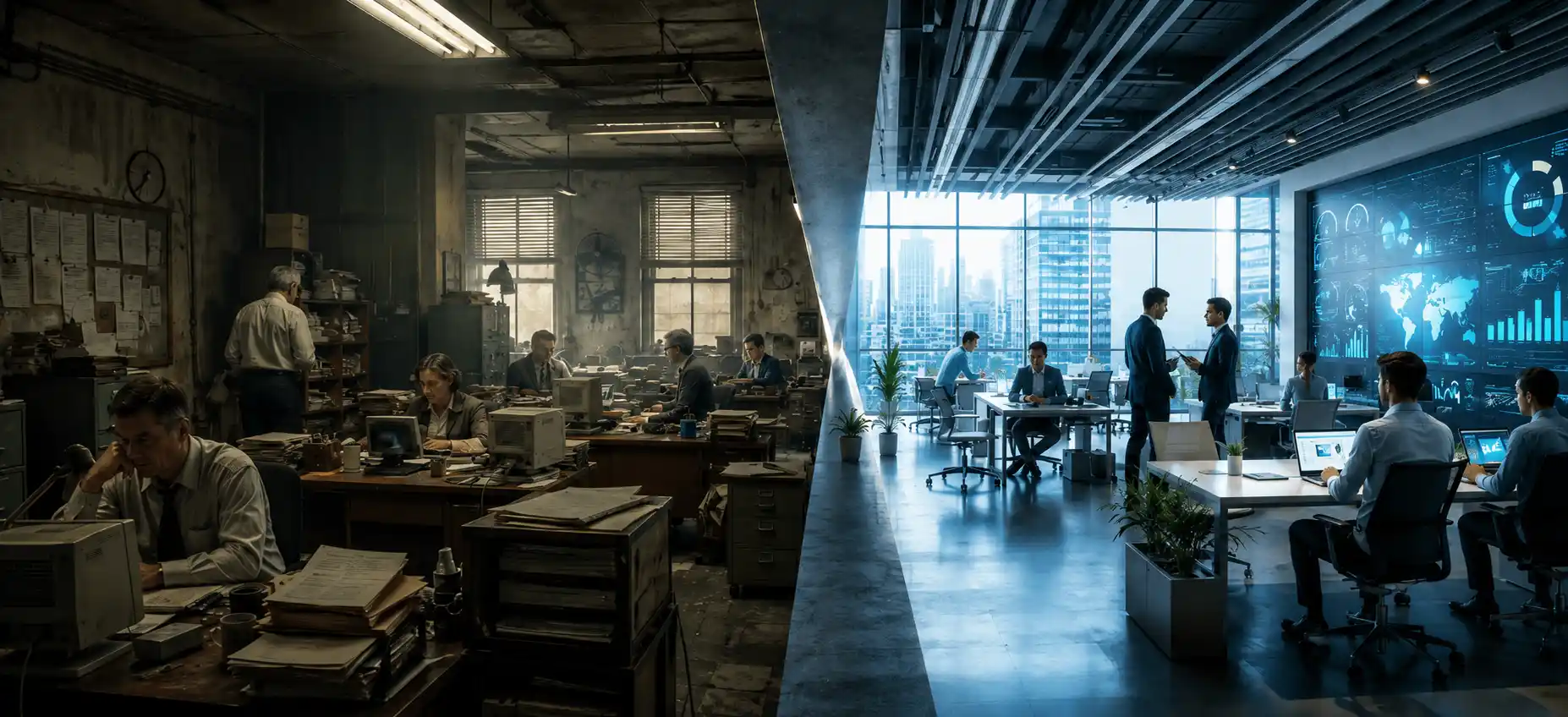
As the time evolves, the rules of biology are now being shifted from the forest to the world of technology, and this is called Digital Darwinism. The environment in nature changes in hundreds of years, but in technological world, the changes occur in literal months. In the business world companies do not only fight over raw material, they also fight for people’s attention, data and liquidity. Whenever there is a change or a shift in technology like the use of Generative AI, or a transition to cashless society, it is like a big storm that can hurt companies that are not ready. Companies that have been around for a time and are used to doing things in a conventional way, find it hard to change. On the other hand, companies that are agile and can adapt change quickly are the ones that will survive. These companies do not think of their business as a fixed genetic code instead they consider it as a set of traits that can be reconfigured through software updates and data analysis. In this digital ecosystem, the penalty of not adopting the advanced methods is not just the decline in profits, but a total extinction from the ecosystem. Like animals have to change to survive, companies have to adopt change to survive too.
The phenomenon of Adapt or Fade Why Your Company's 'Thick Fur' is Making it Extinct in the Age of AI.
This idea of Survival of the Fittest leads to a choice: Adapt or Fade. Adaptation is a conscious yet difficult decision of adopting change, evolving all the time and to think of your business as a living thing not just a static piece of document. It is a constant cycle of unlearning and relearning. On the other hand, to fade means to slowly disappear and this often happens when a company is doing well but is not moulding according to the requirements of the time. You’d be surprised to know that the fading usually starts during the successful years of the company, when the leader thinks they’ll go places but in reality, they are falling behind. They ignore the challenges coming their way. New era has to bring new ideas, successful people usually think their policies are so strong to survive the pandemics but actually, adaption is the only way that leads to success, no policy is strong enough to survive challenges that come from an outdated system. The results of fading begin with talent haemorrhage, when the company eventually start losing its employees, and the customers to other competitive organisations. So, to be in the game, it is very important to keep updating.
The case study: Nokia vs iPhone
In early 2000s, Nokia was the "Apex Predator" of the mobile world. They had a 40% global market share and over 1 billion customers. Their phones were famous for being indestructible. Their hardware was their strength and they were actually cashing the fact. While on the other hand, the first iPhone released, was considered weak. But the strength of iPhone was its superior operating system (iOS), and an app store. Apple thought it was not a phone anymore, it was a ecosystem, and with their strengths, it survived. While Nokia which didn’t think phone was more than just texting and calling, it sold its business to Microsoft for a fraction of its former value. Nokia clearly focused on its thick fur, not knowing that apple has a DNA advantage. This shows how adaption is important, no matter how extraordinary you are in your times, somebody else with better understanding of the requirements of the new world, will take over your place.
Careem Scenario; The danger of a motionless pioneering
In context of a country like Pakistan where people care a lot about what others think, if a company is seen as fashioned it can be very hard to become relevant again Careem was the first company to provide online cab services in, not only this but it also impacted the whole public transport of the country, it changed the way people moved around in cities. However being a pioneer often creates an impression of superiority, where the company thinks it is invincible and do not need to change. When the economy in Pakistan changed and fuel prices went up, Careem’s way of doing business became too expensive. Other companies, like inDrive and Yango were able to change and adapt to the situation and they became more popular. Careem’s example shows that just because a company is a pioneer it does not mean it will always be successful.
Real Estate Evolution: From Speculative Paper to PropTech Transparency
The Pakistani real estate sector is changing a lot now. This sector has always been a safe investment option for the people in Pakistan. Initially the real estate sector was all about paper records, until the system was updated, It remained all about papers and files. People would have no choice but to buy plots of land without basic necessities like water, and stable roads. Nobody really knew what was going on behind the curtains, since everything was kept confidential.
As the time has passed, people are more concerned about clear communications with no loopholes. The old methods of record keeping in real estate are starting to fail, therefore the companies have started adapting new methods and techniques, and even introduced blockchain to keep the records intact. It is now very easy to see which land is owned by whom. The thing is that the people investing in real estate are not all in Pakistan, some overseas Pakistanis also wish to invest and also have a full check of what land they are buying, therefore they can now access full 3D tours of the buildings, drone shots of the area all the inventory and pros and cons of the projects, they can also know about the credibility of the builder.
Companies that lack the sense of technological advancements, are lacking behind. They are not just losing the customers but also their trust in them. Sooner or later, such companies will fade away from the market.
The Banking Sector: The Giant vs. The Digital Native
For a time the banks in Pakistan that were thought to be the strongest were the ones with a lot of branches and big buildings in every city. These banks had been around for a long time and would circulate a whole lot of money throughout the country. Then, with time, things started to change, a lot of banking systems were replaced by online platforms, and these big banks, very well known, lacked behind because they had a lot of paperwork which was nearly impossible to shift to online records.
On the other hand, Digital Wallets and Neo-banks like EasyPaisa, JazzCash or SadaPay came into the market without any branches and not as much money. They were not stronger in the way but they were perfect for people who wanted to pay bills and send money quickly from their smartphones. Now the big banks are trying to catch up by making their digital services better. The smaller Digital Wallets and Neo-banks like EasyPaisa, JazzCash or SadaPay have already become a big part of the modern Pakistani street economy. The Digital Wallets and Neo-banks are doing well because they understand what people want.
The Textile Industry: The Bulk Weaver vs. The Value-Adder
Pakistan is home to some of the worlds textile mills, which are huge industrial factories with thousands of machines. In the past, these mills were strong because they produced a lot of fabric. When global energy prices went up, and the International Monetary Fund stopped subsidizing power in 2024-2025 being big became a problem. The huge energy bills made their amounts of fabric too costly for the global market. Today the mills that are still operating aren't necessarily the ones with the machines. Instead they are the ones that found ways to survive by turning to energy and focusing on making high-quality eco-friendly fashion instead of cheap fabric.
They understood that what was needed wasn't fabric but smarter fabric that used less electricity. The biggest mills that didn't adapt are now closing down while the efficient ones are increasing their exports. These efficient mills make fabric that's not only good for the planet but also in demand globally. They are the ones that will shape the future of Pakistans textile industry.
The Institutional Crisis: The Narrowing Window for Academic Adaptation
This fight between getting better and dying out is really clear in Pakistan’s schools. These schools should be helping students adapt. Often they stop progress. Many of Pakistan’s universities still use an old model. They teach the things they have been teaching for years, things that were made before AI and remote work became normal. They do not try to be as good as schools. They do not teach technical skills in their main programs.
These schools are failing a test. They make graduates each year. These graduates have a lot of knowledge but not the skills that employers want. These schools are not doing well in rankings. Employers do not prefer them. Special schools that teach skills are becoming more popular. These schools change their teaching often.
A school that does not change what it teaches often is not just falling behind. It is preparing students for a world that does not exist anymore. Institutes must change what they teach often to be good. If not they will not be useful. The job market wants people who're ready to work now. Institutes must teach what employers want. Many institutes are not doing this. They are making students for a world that's not here. This is very bad. Institutes must change now. They must teach skills. They must be, like schools. If they do not they will die out. This is the reality. Institutes have to adapt. They have to change. They have to be good. They will not exist.
The Static Businessman: The Individual Architect of Failure
Finally, consider the point of view of the businessman like the traditional CEO or entrepreneur who thinks that thirty years of experience and doing things the way they have always been done is the best way. In 2026 this way of thinking is the reason that companies fail. This businessman usually sees transformation as something that is not really necessary just a fancy thing that people talk about. He does not think it is a tool that he needs to survive. A businessman who will not change his supply chain to a cloud-based tracking system or who does not care about wallets is basically giving up. He is trying to compete with companies that are moving very fast but he is still doing things the old way. The market today does not care about people who like to do things the way. It cares about people who can solve problems for their customers in the best way possible with the least amount of trouble. For the businessman the choice is not about just getting a little better or staying the same. The choice is between working hard every day to keep up with the times or disappearing slowly and being forgotten like a warning story about what happens when a leader does not know how to change. Digital transformation is not a luxury it is a necessity. The businessman must adapt to the way of doing things or he will be left behind. The businessman has to make a choice. It is a very important one.