
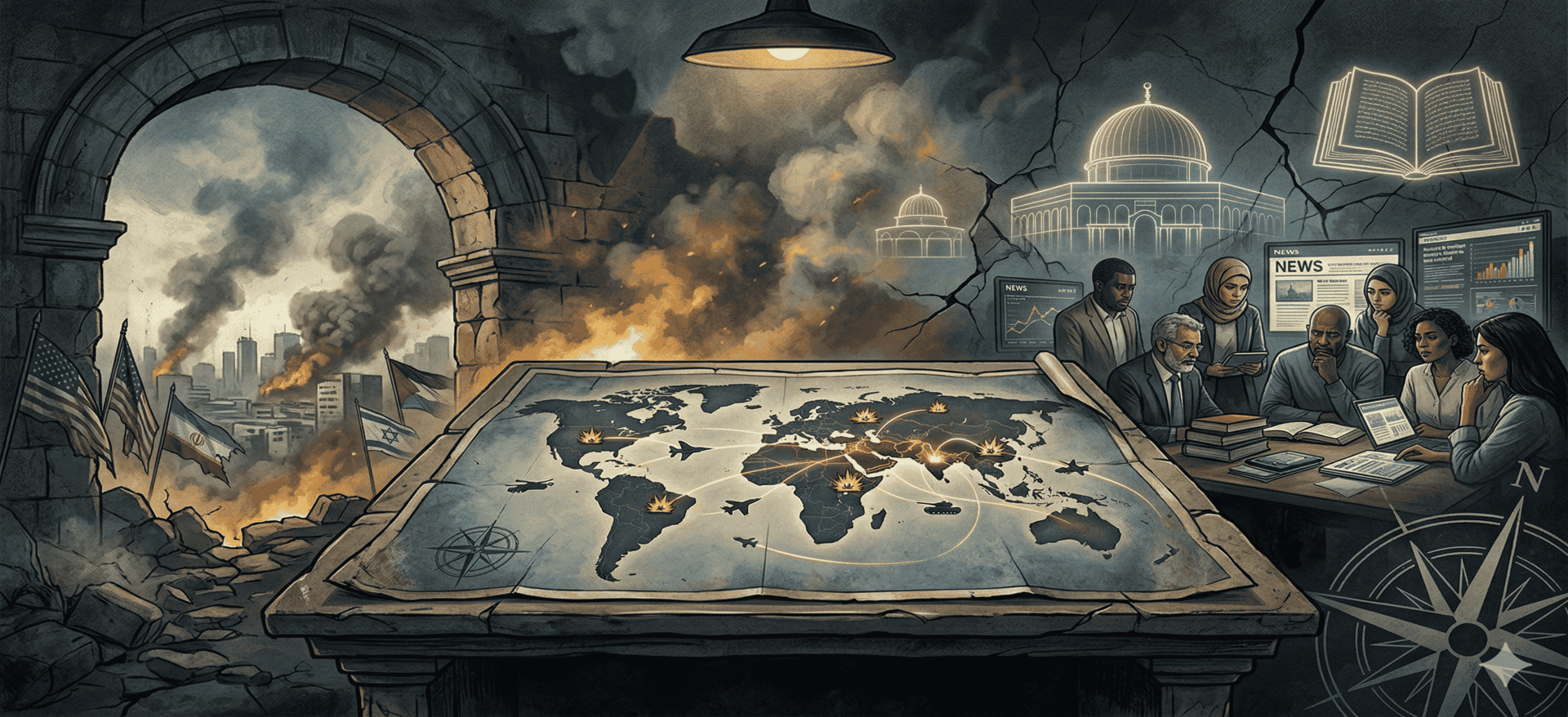
Is The World Approaching The End? Understanding Today’s Global Conflicts And Uncertainty
Author - Ovais Ali Khokhar
Is the World Approaching the End? Understanding Today’s Global Conflicts and Uncertainty
I want you to reflect on the fact that we are in the most unpredictable times of the history, 2026 will be undoubtedly remembered as the most chaotic year of the century.
In just a matter of weeks, different conflicts and tensions between the states have risen into major crises, effecting the powerful, influential and major regimes of the world. This looks like the world is on the verge of being collapsed, not just geopolitically, but spiritually, historically, and ethically.
The truth takes time to unfold, things are never too easy to be understood just like that. Always research, reflect and then decide. In this article, I will be reflecting on my thoughts regarding the current scenarios that shape or reshape the world.
The escalating conflict: a volatile standoff between Iran, the United States, and Israel
As the end of February 2026 was approaching, the United States and Israel launched coordinated military strikes deep inside Iran, targeting the major leadership of the country, resulting in the Martyrdom of Iran's Supreme leader Ayatollah Ali Khamenei, Ali Shamkhani, Senior Advisor to the Supreme Leader, Mohammad Shirazi, Head of Supreme Leader's supreme bureau, Muhammad Pakpour, Commander of the Islamic Revolutionary Guard Corps, Aziz Nasirzadeh, Defense Minister of Iran, including 201 people were all reported killed inside Iran in the result of the airstrikes.
In the response to the attacks, Iran launched missile and drone attacks on the United States and Israeli bases across Middle East, which clearly gave rise to tension between Iran and the Gulf Nations. The retaliation was natural but causalities were reported, this led to a very chaotic point where protests started within Iran and even in other Countries including Pakistan where people were mourning the death of Ayatollah Khamenei, out of rage they attacked the U.S. consulate based in Karachi, and at least 10 people were reported killed in clash between the protestors and the Security forces.
The confrontation has escalated the conflict since the most powerful states are in a war situation, this has sparked a Global Alarm, the escalation can go wider and we have to accept the fact that we are in a state of active War considered by some as WW3.
Border Escalation: What's Causing the Pakistan-Afghanistan Conflict?
While Middle East is in chaos of War, the south Asia has also been declared as a hot zone since tensions between Afghanistan and Pakistan arose when Afghan Taliban forces launched cross border attacks on Pakistan Military positions, on Durand line. In response to these attacks, Pakistan launched retaliatory strikes in Afghanistan declaring it an Open War. This no more is a border conflict, instead it adds to the broader conflicts happening in the world, this has drawn serious international attention creating fear and instability among the region.
Why the Current Unrest Around the World Feels Like a Historical Turning Point
Any person who thinks, has intellect, and a mindful nature, has a lot of questions to ask, I'll list those questions with the answers from my understanding.
- Why are multiple wars breaking out at once?
- Why are global powers directly involved on several fronts?
- Is it the time that Israel becomes Greater Israel?
- Can Masjid al Aqsa become 3rd temple for Jews soon?
- Can Iran proceed to become a Secular state?
- Can Pakistan be the next target of Israel?
Due to long-standing political tensions, regional rivalries, and power struggles that have been developing for years, a number of global conflicts are emerging simultaneously. Unresolved conflicts can easily escalate into outright wars when diplomatic mechanisms deteriorate and international trust wanes. Rather from being isolated incidents, the ongoing conflict between Pakistan and Afghanistan and Iran, the United States, and Israel reflects a broader pattern of global instability.
Because today's wars are linked to strategic objectives, such as trade lines, oil supply chains, military alliances, and regional security, major nations are involved. Wars in the Middle East or South Asia can have an impact on global markets and political power in a globally interconnected globe. Because of this, strong countries frequently step in when they think their geopolitical position or national security is under jeopardy, also remember that power today can not stay with one impactful leader or country, it has to revolve, that matters a lot when we talk about why a lot of countries get involved into wars.
Particularly during periods of regional crisis, the concept of "Greater Israel" is frequently brought up in political discussions and media narratives. There is no official announcement that Israel is formally pursuing a plan to expand its borders beyond internationally recognised lines, despite the fact that some political organisations support territorial expansion. However, the struggles tell a lot about it, It will happen sooner or later but we always have to wait for some real evidences to claim such a thing.
One of the world's most delicate places of worship is Masjid al-Aqsa. While some fringe groups advocate for the construction of a Third Temple, current international agreements and political realities make such a move extremely unlikely in the near future. Any attempt to change the status quo would result in a huge worldwide backlash, making it a highly unstable and unlikely scenario.
Iran's political system is firmly anchored in its Islamic Republic structure, despite recent geopolitical unrest and domestic instability. Without significant internal reform or systemic change, a swift shift to a secular state is unlikely. Although there are opposition movements, structural institutions are still very much in place.
There is no solid proof that Pakistan is a potential military target. Although political rhetoric and regional tensions may instill dread, official strategy should not be confused with speculation. Direct escalation is unlikely absent unusual circumstances because Pakistan is still a major regional power with its own defence capabilities and allies.
Chaos, Prophecy, and Global Anxiety
When war evokes from different ends including Middle East to South Asia, it creates an obvious feeling of instability.
For believer, such events are sometimes considered as:
- Prophetic indication of end times (trial)
- The influence of misleading forces on the societies
- Situations in which Moral and Spiritual turmoil are expected
Global Instability and Public Anxiety: Searching for Meaning Amid Chaos
When a major regional power like Iran is attacked and U.S. bases in the Middle East are attacked in retaliation, or when Pakistan and Afghanistan are at odds, it doesn't appear or feel like distinct events; rather, it feels like mounting pressure across several geopolitical fault lines.
In the current period of extreme worldwide instability, military escalation can happen in a matter of hours, and retaliation can happen just as swiftly. Political miscalculations now have global repercussions rather than just local ones. Aggressive language, swift alliance changes, abrupt regime changes, and cross-border strikes are not isolated incidents; rather, they are indicators of a precarious and changing global order.
Unlike previous decades dominated by a single superpower, today's world is multipolar and highly competitive. Power is distributed across regions, and tensions in one area can immediately affect another. When conflict erupts in the Middle East, global markets react. When leadership changes occur in one country, diplomatic relationships worldwide feel the impact.
That is why this moment feels different. That is why fears of a larger global conflict or even World War III are resurfacing in public discourse.
It may not necessarily mean that the world is ending, but it does suggest that the rules shaping international politics over the past few decades are shifting in real time. The global balance of power is being tested, and the international system appears more reactive and unpredictable than ever before.
Geopolitical tensions' effects on global financial and economic conditions
The rising tensions in the geopolitics of the world have significant implications for the global economy and financial conditions specially in energy markets, trade flows, and financial stability. When wars occur, the whole world's economics is at stake. Food becomes expensive, Oil, gas, transport expense rise up, In fact, the trade market also start fluctuating. Such situations actively effect the financial decisions of the countries.
Natural resources such as oil and gas' transportation and production are effected. For example, when Russia tried to invade Ukraine, the supply of energy to the Europe was restricted, and altered global gas and oil trade patterns, while instability linked to the US, Israel and Iran war has raised concerns about wider disruptions in the Middle East, since Iran has been actively attacking the US bases in different countries of Middle East. Such tensions increase uncertainty in global markets, often causing spikes in energy prices and higher transportation and insurance costs for international shipping.
Basically, the rising tension in geopolitics is reshaping the global economics, undoing the conventional methods and adopting the conduct that is appropriate in today's time. Countries are actively reconsidering their conduct of energy security, trade partnerships, and supply chain to decrease the chances of collapse. This shift is gradually fragmenting the global economic system and encouraging new alliances and trade routes. As a result, geopolitical tensions are no longer confined to political or military domains; they are deeply intertwined with economic stability, energy security, and the long-term trajectory of global financial markets.
The war scenario not only affects the prices of resources but it also effects the trade of the world, businesses delay investments, foreign investors withdraw money, infact the trade between countries also get delayed. The stock markets become unstable, investors start moving their money to safe assets.
It won't be wrong if I say that war is a curse that insists countries to invest more in military and weapons instead of Education, and infrastructure. Not only this but the loss of money connected with the destruction of infrastructure during war is also a major concern that should be addressed. Wars come with a lot of destructions, instability and uncertainty. In such times, countries that take the calculated moves, survive.
How Should We Respond to Growing World Tensions?
History shows that nothing ends overnight, global events take place in coordination with one another and we have seen humanity surviving through pandemics, world wars, and global economic collapses, we have only learnt and evolved through these turmoil. This can never be denied that we are living through one of the most distress periods of modern times but instability is not same as obscurity.
The world is shaking but our choices of moral conduct, ethics, and social responsibility will help us survive.
In times of turmoil:
- It becomes crucial to strengthen moral clarity and faith.
- It's important to avoid panic and false information.
- It is still essential to uphold.